CPAP Alternatives for Sleep Apnea: Your Options Beyond the Machine

Effective sleep apnea treatment only works when a patient uses it consistently. That sentence sounds obvious. It is also the thing I have thought about most in twenty years of treating obstructive sleep apnea, because a therapy that sits in a closet protects nobody.
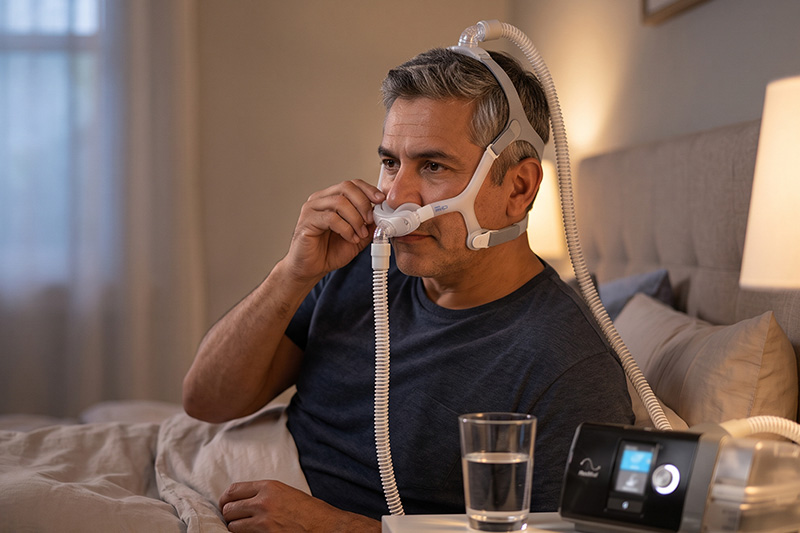
Continuous positive airway pressure, or CPAP, is one of the most effective treatments we have for obstructive sleep apnea. Delivering pressurized air through a mask prevents the airway from narrowing during sleep, which is what causes snoring and "apneas," or pauses in breathing. Those interruptions limit the oxygen your body gets during the night.
But do people use CPAP every night?
Some struggle with mask discomfort, air leaks, dry mouth, nasal congestion, claustrophobia, noise, bloating, or the plain inconvenience of traveling with a machine. Others use it regularly and still find it hard to tolerate. Usually there is a fixable reason behind that: the wrong mask, a stuffy nose nobody ever treated, a pressure setting that was never revisited.
Here is the part I want you to hold onto. If CPAP is not working for you, that does not mean you should stop treating your sleep apnea. In my practice, roughly half of our patients end up on CPAP and roughly half end up on a custom oral appliance. Which one you land on depends on your diagnosis, your anatomy, your health history, and the severity of your condition. Both are real medicine. Nobody should be talked into a device they hate.
Why Some Patients Cannot Tolerate CPAP
Adjusting to CPAP takes time for most people. The correct mask, pressure settings, humidification, and a clinician who picks up the phone when something goes wrong make a very large difference.
Common reasons patients stop using CPAP include:
- An uncomfortable or poorly fitted mask
- Dry mouth or nasal passages
- Nasal congestion
- Air leaks
- Skin irritation or pressure marks
- Claustrophobia
- Difficulty falling asleep with the mask
- Swallowing air and waking with bloating
- Feeling restricted while changing positions
- Difficulty using the machine while traveling
Before you abandon CPAP, speak with your sleep specialist. A different mask, heated humidification, a pressure adjustment, or a gradual acclimation at home resolves most of the list above.
One pattern I see constantly is worth naming here. A patient gets tested somewhere, a machine shows up from a supplier, and nobody ever sits down and explains the diagnosis. Durable medical equipment companies are not medical clinics. They are resellers. So when the mask hurts at 2 a.m., there is no physician in the loop to fix it, and the patient quietly quits and decides he failed. He did not fail. The care around the device failed.
When those changes are not enough, it may be time to consider another treatment.
Oral Appliance Therapy
A custom oral appliance is one of the most established alternatives to CPAP for patients with obstructive sleep apnea.
The device is worn in the mouth during sleep. It gently advances and stabilizes the lower jaw, helping prevent the tongue and surrounding tissues from collapsing into the airway.
Unlike CPAP, an oral device:
- Does not require a mask
- Does not blow pressurized air
- Operates silently
- Does not need electricity
- Is small and easy to travel with
- Can allow greater freedom of movement during sleep
Oral appliance therapy is often considered for people with primary snoring or mild-to-moderate obstructive sleep apnea. Selected patients with more severe apnea who cannot tolerate CPAP may also be candidates, although those decisions have to be made one patient at a time.
Two things matter here, and I am firm about both.
First, the appliance should be prescribed by a medical provider and fitted by a qualified dentist, using a custom, adjustable device. The American Academy of Sleep Medicine and the American Academy of Dental Sleep Medicine both recommend custom titratable appliances over non-custom devices. An over-the-counter mouthguard is not a cheaper version of the same treatment.
Second, you need a sleep test before, and follow-up testing after. I have had this argument more than once with people who wanted to hand out appliances on the basis of snoring alone. If someone is young and healthy, takes no medications and simply snores, the risk is small. If he has hypertension, or heart disease, or he is past a certain age, you are guessing. Follow-up testing is how we confirm the appliance is controlling obstructive events. Quieting the noise is a different thing, and it is easy to mistake one for the other.
Positional Therapy
Some people have most of their obstructive events while sleeping on their back. This is known as positional obstructive sleep apnea.
Positional therapy encourages side sleeping through wearable trainers, vibration devices, specialized belts, or supportive pillows. It works well for carefully selected patients. It usually disappoints when breathing is disrupted in every position, which describes most people with moderate or severe disease.
Weight Management and Lifestyle Changes
Weight loss reduces the severity of obstructive sleep apnea in many patients, because excess neck and airway tissue contributes to the obstruction.
Depending on your needs, a clinician may recommend nutrition support, physical activity, behavioral treatment, medication, or a bariatric evaluation. The GLP-1 medications have changed this conversation, and a trial published in the New England Journal of Medicine showed real reductions in apnea severity with Tirzepatide.
I want to be careful about what that means for you personally. Two things turn up in clinic over and over. Not all patients who have sleep apnea are overweight. And most people who lose weight on these drugs plateau. I hear a version of the same sentence almost weekly: I lost weight, then I got stuck, and I still feel terrible. Their apnea improved without going away. Waiting six months or a year to find that out is a long stretch of bad nights for your heart and your brain.
Other helpful measures may include:
- Avoiding alcohol near bedtime
- Reviewing sedating medications with a provider
- Stopping smoking
- Treating nasal congestion
- Maintaining a consistent sleep schedule
- Exercising regularly
Lifestyle changes improve treatment results. They are not a reason to leave diagnosed sleep apnea untreated while you wait for the scale to move.
Nasal EPAP Devices
Expiratory positive airway pressure, or EPAP, devices fit over or inside the nostrils. Small valves create resistance when the patient exhales, producing pressure intended to help keep the airway open.
These compact devices do not require a machine or electricity. They also are not appropriate or effective for every patient, and some people find it genuinely unpleasant to exhale against the resistance.
A sleep specialist can help determine whether an FDA-cleared EPAP device is reasonable for your situation.
Inspire and Upper Airway Stimulation
Upper airway stimulation is an implanted treatment for certain patients with moderate-to-severe obstructive sleep apnea who cannot use or benefit from CPAP.
The system monitors breathing and stimulates a nerve that moves the tongue forward, reducing airway obstruction during sleep. Implantation requires surgery, and patients must meet specific medical and anatomical criteria.
An airway examination, sleep-study results, body mass index, type of airway collapse, and previous CPAP experience all affect eligibility. Part of that workup is a drug-induced sleep endoscopy, which shows how and where your airway actually gives way.
Inspire can be very effective in appropriately selected patients. It is also more invasive and more expensive than the nonsurgical options, so in my view it belongs later in the conversation, after an oral appliance has been tried or ruled out.
Other Surgical Treatments
Surgery may be considered when a clear anatomical problem contributes to airway obstruction. Options can include procedures involving the tonsils, soft palate, tongue, nose, or jaw.
I trained as an ear, nose and throat surgeon before I trained in sleep medicine, so let me be blunt about this. The right procedure depends on where the airway collapses, and results vary a great deal from patient to patient. Surgery does not eliminate the need for follow-up testing, and it does not always eliminate the need for additional treatment.
How to Choose the Right CPAP Alternative
There is no universally "best" alternative. The right treatment depends on:
- Sleep apnea severity
- The location and pattern of airway obstruction
- Sleeping position
- Dental and jaw health
- Weight and other health conditions
- Previous treatment experience
- Personal comfort and preferences
One more thing. Do not stop CPAP without a plan for what takes its place. Untreated sleep apnea keeps doing damage even when the snoring quiets down and you feel like you are getting away with it.
Find an Option You Can Actually Use
If you cannot tolerate CPAP, you still have options. The BlueSleep providers can review your sleep study results, go through exactly what went wrong with CPAP, and determine whether a custom oral appliance or another treatment may be appropriate.
Schedule a consultation and let us find a treatment that controls your sleep apnea and fits into your real life.
Jordan Stern, MD
BlueSleep Founder, CEO and Medical Director
Our latest stories